






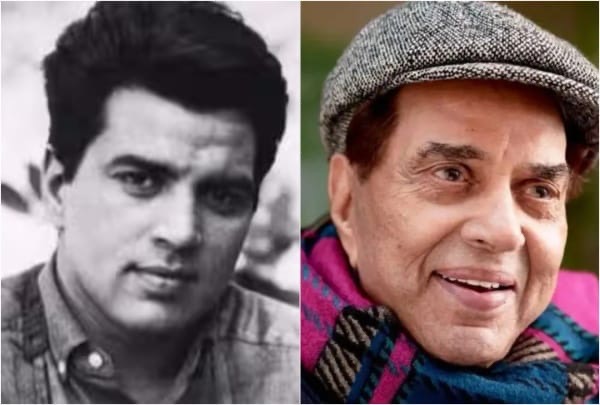
Indisputably, Dharmendra is the “quintessential leading man of Hindi Cinema.
He is idealistic and a legend in his own lifetime.
Fondly addressed as
‘He-Man of B’town, he enjoys a six-decade legacy defining heroism, love, and humility in Indian cinema. From the OP Ralhan directorial’Phool Aur Patthar’ featuring Meena Kumari to the Ramesh Sippy directorial ‘Sholay’ and Hrishikesh Mukherjee directorial’Satyakam’ featuring Sharmila Tagore, his journey is one of courage determination, kindness and a life of both stardom and dreams.
He enjoys an extraordinary legacy that spans more than six decades — one that redefines heroism and masculinity on the Hindi screen.
Born Dharmendra Kewal Krishan Deol on December 8, 1935, in the village of Sahnewal near Ludhiana, Punjab, he grew up far removed from the glamour of Bombay(Mumbai) In several interviews over the years, Dharmendra often recointed his modest beginnings a boy who would walk miles to school and daydream about films. He was merely a boy from the soil who wanted to see himself on the screen. This once he told Filmfare, adding that even when success came, he always felt like that same boy from the village.
Dharmendra made his debut in ‘Dil Bhi Tera Hum Bhi Tere’ after winning a talent contest by Filmfare magazine. But recognition came soon after with ‘Shola Aur Shabnam’ and ‘Bandini’ . By the mid-’60s, Dharmendra had begun his ascent as Hindi cinema’s quintessential leading man — a combination of strength and disarming charm. He emerged as a part of some of the most defining films of Indian cinema: ”Mera Gaon Mera Desh’ ‘Sholay’ Chupke Chupke’ and ‘Dream Girl’.
The media calls him “the He-Man of Bollywood”, but the label is only partly accurate. Beneath the rippling biceps and smouldering looks was an actor who brought rare empathy to his characters. In Hrishikesh Mukherjee’s ‘Anupama’, he played the introspective writer who wins over a reclusive woman with warmth. In ‘Satyakam’, he is the idealist crushed under the weight of a corrupt world — a performance critics still hail as one of Hindi cinema’s finest. And in ‘Sholay’, as Veeru, he immortalises camaraderie and romance with effortless grace.
In one of his old interviews with he reflected, he is but an ordinary actor, adding the Almighty gave him all that he wanted to give, but didn’t give what he asked for
when asked about having regrets in life. That earthy humility was no act — it was who Dharmendra truly was.
If Dharmendra is the archetypal action hero on screen, in love, he is every bit the poet he admired. His romance with Hema Malini, the ‘Dream Girl’ of Indian cinema, remains one of Bollywood’s most storied love sagas. Their chemistry first sparked on the sets of ‘Tum Haseen Main Jawaan’ and intensified through a series of films, from ‘Seeta Aur Geeta’ to ‘Sholay’. Regardless social criticism for choosing to marry a second time while still married to his first wife, Prakash Kaur Dharmendra faced it with conviction.
He didn’t hurt anyone intentionally. In the 1983 interview. Hema, too, had said in her memoir ‘Hema Malini: Beyond the Dream Girl’, He stood by her like a rock, through all the noise. He was, and remains, a man of immense strength and softness a rare combination.
Together, they have built a life of intense companionship and mutual respect, away from the glare of cameras. Their daughters, Esha and Ahana Deol, often spoke of their father — a man who writes shayari for his wife, remembers her favourite songs, and still calls her “meri Hema.” That love, steadfast and unpretentious, is the poetry that runs beneath his He-Man persona.
Off-screen, too, he remains refreshingly human in an industry that often confuses fame for divinity. He loves poetry shayari, and the silence of his Lonavala farmhouse. Even in his late 80s, he posts videos of himself driving a tractor or tending to crops, urging his fans to live simply.
Dharmendra’s illustrious filmography reads like a timeline of Hindi cinema itself: from black-and-white social dramas to
multi-starrers of the ’70s, from patriotic blockbusters like ‘Haqeeqat’ to comedies like ‘Chupke Chupke’, and action sagas like
The Burning Train’ Even in his later years, he continued to reinvent himself — in ‘Life In A Metro’ ‘Apne’ and ‘Rocky Aur Rani Kii Prem Kahaani’ 2024 where his cameo reminded audiences of his enduring charm.
Awards and honours have followed him through the years: the Padma Bhushan in 2012, numerous lifetime achievement awards from FICCI, MAMI, and international bodies, including the State of New Jersey. In 2004, he briefly entered politics, serving as a Member of Parliament (Lok Sabha) from Bikaner, Rajasthan.
Yet, he never lost sight of what mattered most to him — his audience. “My biggest award,” he once said at an event, “is when a common man smiles at me with love.”
Dharmendra’s family includes wives Prakash Kaur and Hema Malini, sons Sunny Deol and Bobby Deol, and daughters Esha Deol, Ahana Deol, Vijeta, and Ajeeta.
His latest film, ‘Ikkis’, directed by Sriram Raghavan and featuring Agastya Nanda and Jaideep Ahlawat, among others, will release this December –a war drama a courage and legacy, themes that defined Dharmendra’s life on and off the screen.
Earlier in a Doordarshan documentary when asked how he would like to be remembered, Dharmendra smiled softly and said: “he loves country, people – and merely wanted to be remembered for that
The He-Man of Bollywood is acknowledged for his warmth, his humility, and his golden-age charisma, which continue to echo through every reel of Indian cinema.
News Edit KV Raman