





When sisters Ranjani and Gayatri echoed at the Royal Albert Hall
The sisters share their experience of their performance at the iconic venue for Darbar Festival.
The sisters take Carnatic music to a popular global platform
In their 38 years of performing across the world, the sisters have seen many unforgettable audiences. However, when was the last time they saw 5,000 people immensely immersed and emotionally tuned in for the entirety of an Indian classical concert? That too, outside of India?
They were a witness to it last week at the Royal Albert Hall, London.
This was a crowd that came seeking the Indian classical experience. It was the 20th anniversary of the Darbar Festival, celebrated in the way they do best: by presenting pristine Indian classical music on one of the world’s grandest stages.
The evening featured a double bill: Carnatic concert followed by Hindustani recital with thumris by Kaushiki Chakraborty.
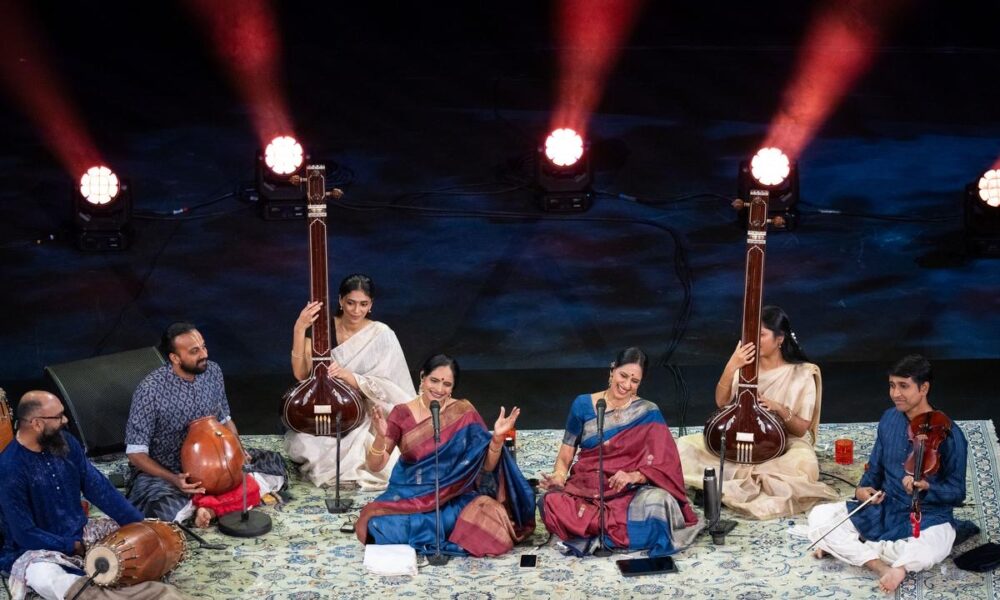
Ranjani and Gayati were accompanied by Vittal Rangan on the violin, Sai Giridhar on the mridangam and
S. Krishna on the ghata.
Their’s was a full-fledged madi kutcheri, complete with Tyagaraja, Dikshitar and Tamil kritis and an expansive Ragam-Tanam-Pallavi, much like what they would have presented in a Mylapore Sabha or a Bengaluru Pandal.
The Royal Albert Hall is vast and imposing. No sooner they began to sing, it transformed into something intimate, like the warmest of baithaks. It was heartwarming to see the audience tune into every nuance, respond at just the right moments, and stay connected in a beautiful loop of emotion. In the Kalpanaswara section, they presented their innovation ‘Swaradhuri’, a parallel singing of three ragas connected through Grahabedham. By the time they concluded with a Marathi abhang, the energy in the hall was palpable.
With an excellent team Vittal Rangan on the violin, Sai Giridhar on the mridangam and
S. Krishna on the ghatam singing felt effortless. A large part of this magic was made possible by the exceptional acoustics. The visual aesthetics, the sound design, the seamless backstage facilitation — all contributed to the experience.
Infact, they have performed for Darbar many times across venues in London and once in Italy. And, each time, the bar is raised by Sandeep Virdee, the man behind Darbar. From lighting and backdrop to camera angles and the colour of the performers’ attire, every detail carries intention. In their land, there is no shortage of great music or gifted performers. They need dreamers those who can imagine big, curate with vision, draw audiences consistently irrespective of the artiste and need more such spaces where classical music can reclaim its place in the imagination of a world addicted to 60-second reels.
It’s a rare privilege to represent Indian classical music on this exalted stage. They stand here because of the countless contributors who have nurtured this art form with devotion, artistry and integrity, and this moment belongs to them too. They are reminded that when classical music is rendered with imagination, soul and sruti suddham, it reaches everyone — from a deeply-moved Philharmonic conductor who reached out to them to a quiet devotee in a Kerala temple.
News Edit KV Raman