




Like every year, 2025 wasn’t any different when it came to ads. There were good ones, bad ones, humorous ones, terrible ones, and ones that goes beyond mention. Everyone was pleased.
The afaqs! edit team watched all of them every day. The ones the team liked the most and spell out why.
*Aakriti Kochhar
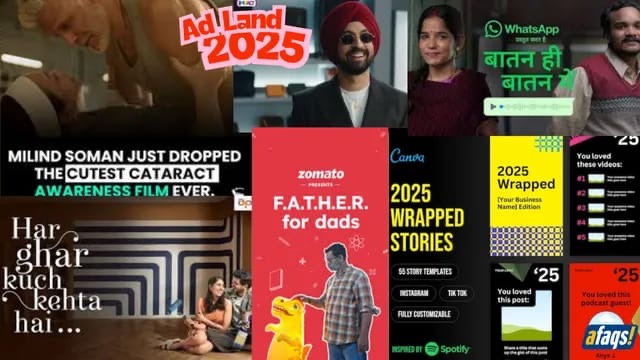
What she really liked over er this ad is how comfortably it uses humour to talk on a topic most people tend to ignore or delay addressing, i.e. cataract awareness. The moment of confusion around blurred vision feels sweet, familiar, and very real, and actor Milind Soman’s presence makes it effortless to watch. It reminded me of how seniors often laugh off early symptoms, turning them into jokes and assuming it’s just age doing its thing. That observation is what makes the ad feel honest. The warmth and wit help the message land without feeling preachy.
What also stood out was how gently the brand steps in without hard selling or creating fear. Centre For Sight has brilliantly positioned itself as caring and attentive, making timely action feel like a natural next step rather than a forced one. The ad legit did its job by keeping the tone light yet meaningful. It stays memorable and leaves you thinking long after the film ends.
*Ankita Madan
She liked the ad because it’s genuinely fun to watch. It starts with Diljit Dosanjh getting a call from Elon Musk asking him to perform on Mars, and the moment he refuses, everything goes wild. The entry of Musk’s ‘goonmen’ turns the film into a playful, over-the-top Bollywood action sequence, with Diljit handling it all effortlessly. What stood out to me was how the brand message slips in so smoothly. Mokobara’s 30-day, no-questions-asked return policy comes through without feeling forced, making the ad entertaining and easy to remember.
*Anushka Jha
“Spotify” Wrapped 2025 stood out not because it tried something new but because it trusted what already existed online. Conceptualised by Kulfi Collective, the campaign leaned into a viral Bads of Bollywood actor Emraan Hashmi–Raghav Juyal fanboy clip, without over-explaining or over-branding it. The ad assumes cultural awareness that you’ve seen the meme, shared it and understand the emotion instantly. “Wrapped 2025” campaign once again turned listening data into a pop-culture moment, proving that the strongest advertising today doesn’t chase attention; it recognises it, making it one of the most culturally fluent brand moments of 2025.
*Benita Chacko
While she and her husband went about building their first home this year, one line kept looping through their conversations: “The house should speak out who lives in it.” One day, as she paused to think about where this thought came from, she realised it had lodged itself in my mind years ago through an Asian Paints ad: “Har ghar chup chaap se yeh kehta hai, ki andar isme, kaun rehta hai.” Subconsciously, she had internalised it. Today, she firmly believes that a home must reflect the people who live in it.
But as we evolve, so do our homes, and so does society. Which is why it is heartening to see Asian Paints evolve along with the times, mirroring changing social values while staying anchored in its core belief.
This year, the brand launched its legacy campaign in a new avatar. Reflecting a more contemporary society, the film shows a couple building a home together, a pet as an integral part of the family, a young boy becoming a food influencer with his grandmother cheering him on, and a little girl paying quiet respect to her grandparents’ photograph. In its understated way, the ad captures how traditions endure even as lives change. It has easily become my favourite ad of the year.
At a time when brands are consciously striving for inclusion, Asian Paints stands out for how effortlessly it weaves this into its storytelling. Nothing feels forced or performative; the inclusivity simply flows as part of everyday life. Even the interiors evolve, reflecting the clean, modern, Instagrammable homes of today. The only thing she missed was late Piyush Pandey’s voice gently anchoring it all in the background.
*Cheenu Agarwal
*30 seconds”
That’s roughly the attention span most ads can hope for today, and for the reel-scrolling generation, it’s probably even less. Yet WhatsApp dropped a full-fledged nine-minute film, and honestly, I’m not complaining.
I watched the entire thing in one go—not like an ad, but like a short film with a quietly beautiful message.
“Baaton Hi Baaton Mein” instantly reminded her of Laapataa Ladies, one of the most heartfelt films of 2025. The emotional texture feels similar – warm, intimate, and rooted in the smallest of human details. The film captures a newly married couple from rural India slowly stitching their bond through WhatsApp’s voice and video notes, accompanied by a sweet background score that makes their everyday moments feel cinematic.
There’s also a lovely nuance in how relationships are portrayed. Women usually address their husbands with pronouns, but how often do you see a man saving his wife’s number with a respectful “Ji”? It’s those little details that made this film my favourite ad of the year.
And somewhere while watching it, I couldn’t help but smile and think – how wonderfully simple things might have been if Phool from Laapataa Ladies had just had a phone.
*Kausar Madhyia
McDonald’s Italia embraced the age-old adage “When in Rome, do as the Romans” with its new—or shall we say ancient—advertising mosaic in June 2025.
It unveiled an 18,000-piece mosaic in Rome’s Galleria Alberto Sordi mall, mimicking an archaeological dig setup, complete with a perimeter to simulate a fresh excavation.
Since archaeological discoveries dating back to ancient Rome in seemingly mundane places like supermarkets are fairly common in the historic city, nothing struck passersby as odd.
However, upon closer inspection of the mosaic, the iconic golden arches were seen hidden in plain sight, with four toga-clad men feasting on McDonald’s classics like burgers and fries.
Towering over the central figures was the Latin text “GAUDEAT CLASSICIS”, which roughly translates to “Enjoy the classics.”
*Mayank Sundriyal
In a category crowded with technical claims and muscle-heavy imagery, The *Whole Truth Foods” went in a completely different direction. “Protein Ke Peeche Kya Hai”? does not start by telling you how much protein you need or why it is better than the rest. It starts with culture, humour, and a question that instantly feels familiar.
What she really liked is how the film uses a well-known Bollywood reference to talk about something most people are genuinely confused about. Instead of explaining labels or ingredients in a serious way, it turns the problem into a song you cannot ignore. You laugh first, but you also get the point almost immediately.
For her, that is what makes this ad stand out. It takes a noisy, mistrusted category and makes the conversation simple, human, and easy to have at home, not just in gyms. It is proof that when the insight is right, you do not need to shout to be heard.
*Muskan Verma
What she really liked about Zomato’s Father’s Day ad was how easy it felt to watch and how hard it hit once it settled in. It starts off playful, almost light, with the idea of fathers being the original apps. But slowly, scene by scene, it turns into something much more personal. We have all seen these moments growing up — dad bringing food home, fixing things without fuss, being quietly present without ever asking for credit.
The use of other app logos was smart but never distracting. It made the point clearer instead of louder. Her favourite part was the lullaby scene. It felt small, intimate, and very real. No background score trying to force emotion, just a father doing what fathers do.
The ending sealed it for me. Zomato stepping away and letting the father take centre stage felt honest. No brand chest-thumping, no over-selling. Just a simple reminder of how much we rely on someone we often forget to thank.
*Shreyas Kulkarni
Honestly, he has no clue why he returned to this ad the most in 2025. He watches a terrible number of ads every day for a living and knows that when he first watched this one, his mental health was disgustingly out of shape, and this Royal Enfield spot reeled him in. His already weary mind found an escape through this commercial.
What is Sawai Padmanabh Singh doing? Is he righting a royal slight from Europe by riding through the continent like a conqueror? Why does the music remind me of a book villain who is still yet disarmingly terrifying?
God, his mind went places, and that is what good, simple ads do. They take you somewhere, and when you return, that brand has a place in your heart.
He isn’t a rider, but does share a soft spot for cruisers. Maybe one day, a Bullet or some cruiser will pierce his. heart and suck out the poison that is flowing into it right now.
Yeah, he still doesn’t know why he watched this ad so many times.
*Ubaid Zargar
“Nike’s bet on Cole Palmer” stands out for him because it felt like a return to form for Nike Football. He grew up watching iconic Nike ads featuring generational athletes like Ronaldo, Ibrahimović, Neymar, Rooney and others – films that didn’t just sell boots but shaped football culture. Over the last few years, that run felt like it had stalled, with fewer campaigns leaving a lasting impression. This film, anchored in Palmer’s rise and Chelsea’s Club World Cup triumph, feels like a step in the right direction. It recaptures belief, swagger and storytelling, reminding me why Nike Football once set the gold standard.
*Vivek Ratnakar
From Ramesh-Suresh to a piano taking a nosedive onto an unsuspecting elderly lady, Cadbury 5 Star’s “Doing Nothing” campaign has served up a delightful buffet of creative spins over the years. Each iteration joyfully celebrates the bliss of taking a break and savouring those leisurely moments without the nagging pressure to stay on the go. This year’s campaign was equally impressive.
The campaign hilariously flipped Valentine’s Day on its head, serving up a delightful alternative to the usual mushy love fest, making sure even the folks who’d rather hide under a rock that day felt included. The ad cleverly uses humour to imply that the quickest route to making Valentine’s Day totally uncool is to let “uncles” take charge—a cheeky wink at how youth trends go belly-up when the older crowd crashes the party.
This unexpected, cheeky twist makes the campaign memorable and entertaining and serves a bigger purpose: empowering people to reject forced romance and embrace authenticity.
News Edit KV Raman