




The intensifying self struggle within the Rashtriya Janata Dal (RJD) in 2025-2026 has been defining feature as a “Deewar” (1975 released Hindi film) scenario, featuring a dramatic showdown amid brothers Tejashwi Yadav and Tej Pratap Yadav.
Based on events unfolding, this comparison stems from
the brother-vs-brother conflict: Much like the film Deewar, where brothers (Vijay and Ravi) represent opposing sides of law and morality, the RJD family feud has seen public, bitter clashes between Tejashwi and his older brother, Tej Pratap.
“Jab ek bhai bolega, ek bhai sunega” (When one brother speaks, the other listens): This classic dialogue was referenced to describe the dysfunction in the RJD household, where public declarations have replaced internal communication.
The “Traitor” Narrative: Tej Pratap, after being reportedly expelled from the party, referred to internal conspirators as “Jaichands” (traitors) and warned his brother, stating, “Some traitors are hatching a conspiracy to finish my political career”.
“Jab ek bhai bolega, ek bhai sunega.”(when one brother will speak one brother will hear)
This line was delivered by Shashi Kapoor with weary moral authority in the 1975 Yash Chopra directorial blockbuster success “Deewaar” featuring Amitabh Bachchan and Shashi Kapoor in pivotal role(s)
The dialogue was meant to convey the idea that fraternity endures, notwithstanding bitterness or betrayal. In Patna, this month, it sounded less like reassurance and more like a question left deliberately unanswered.
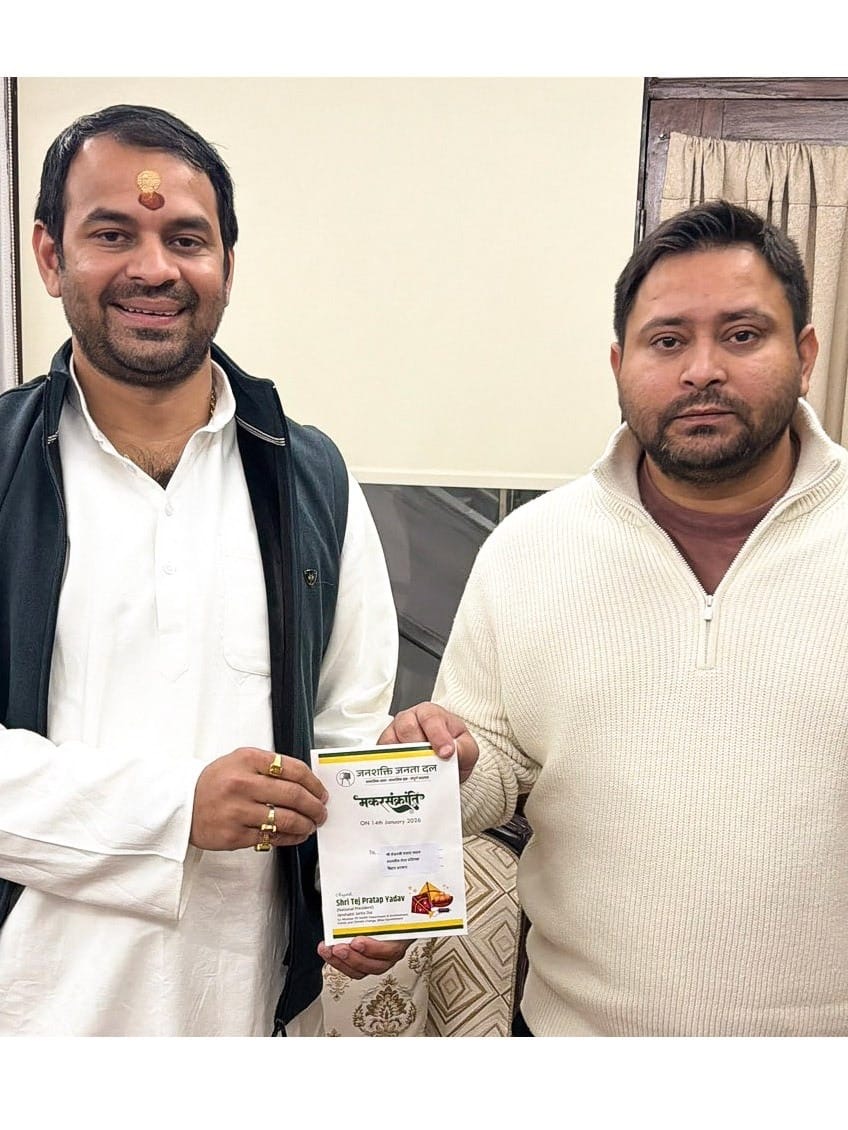
On the eve of Makar Sankranti, Lalu Prasad Yadav and Rabri Devi’s elder son Tej Pratap Yadav arrived at the official residence of his mother. He met his parents and younger brother Tejashwi Yadav an encounter freighted with political and personal history. The two brothers had campaigned against each other in the recent assembly elections.
Tej Pratap lost from Mahua; Tejashwi narrowly held on to Raghopur.
On the evening of January 13, the brothers’ meeting was photographed, carefully framed and promptly shared by Tej Pratap on social media an image heavy with implication. In Bihar’s politics, family photographs are often loaded with messaging. For a moment, it appeared the Lalu household was rehearsing reconciliation or at least signalling a truce.
The moment didn’t last. The following day, as Tej Pratap hosted his dahi-chura bhoj, a ritual fare, political theatre and a Sankranti rite rolled into one-Tejashwi was conspicuous by her absence. Lalu, national president of the Rashtriya Janata Dal (RJD) and family patriarch, did. His presence was read as a signal: Tej Pratap, expelled from the party last May, was not beyond the pale after all.
Tej Pratap filled the silence with accusation. Someone, he said, must have stopped his brother from coming. The name he chose was pointed: Jaychand—the archetypal betrayer of legend, the figure whose counsel led to defeat. The remark was delivered half in jest, half in provocation and entirely for public consumption.
If this was family drama, it unfolded with the precision of a political script. And if it felt familiar, that’s because the RJD has long lived with a paradox: a party built on solidarity periodically undone by fractures within its founding family.
At the centre of that paradox stands Lalu—the patriarch, the original disruptor, the man whose charisma transformed caste arithmetic into a mass idiom. Lalu’s legacy is not merely electoral; it is cultural. He taught Bihar’s marginalised voters to see themselves as protagonists rather than petitioners. But he also personalised politics so thoroughly that succession could never be merely procedural. It would have to be emotional, symbolic and inevitablycontested.
Tejashwi, by design and default, emerged as the principal heir. His claim rests on organisational continuity, on years spent as the party’s operational face, and on the sober contrast he offers to his elder brother’s volatility. Following the recent electoral setback, Tejashwi returned from a long European tour to a party in need of repair. Cadres required reassurance; allies sought clarity; rivals sensed opportunity. In such moments, discipline becomes currency. Attendance matters. Absence—even from a brother’s feast—is read as a political act.
Meanwhile Tej Pratap, has built a career on refusing to be marginal. Expelled from the party, estranged from the household, and armed with a theatrical instinct that oscillates between charm and confrontation, he understands something elemental about Bihar’s politics: attention is power. His Makar Sankranti choreographymeeting family members and political opponents, hosting the feast, releasing the photograph, issuing the barb wasn’t accidental. It was a reminder that the Yadav household still contains an unpredictable variable.
advertisement
That unpredictability unsettles the party precisely because of its timing. The RJD is licking its wounds after poll defeat; its narrative of inevitability has cracked. The leadership’s immediate task is consolidation—of authority, morale and message. Tej Pratap’s interventions complicate that task by dragging private discord into public view. They also reopen an old question the party would prefer to keep closed: how much of the RJD’s identity is inseparable from the Yadav family, and how much can survive beyond it?
The question has been sharpened by voices within the family itself. Lalu’s daughter Rohini has, once again, directed fire on Tejashwi’s inner circle, demanding accountability for the electoral debacle and accusing aides of shielding themselves from scrutiny. Her intervention, widely reported, is not merely a sibling’s grievance; it is a critique of how power is currently organised around Tejashwi. In the Lalu household, disagreement is rarely whispered. It is aired, annotated and amplified.
advertisement
What makes this moment especially fraught is Lalu’s own position. The patriarch’s authority once resolved disputes through sheer gravitational pull. Today, age, illness and legal entanglements have altered that equation. Lalu remains symbolically central but operationally distant. His presence can bless, but it cannot always bind. When he intervenes, it is often read less as command than as counsel—important, but no longer decisive.
This leaves the brothers navigating a landscape without a final arbiter. Tejashwi’s strategy has been to project steadiness: fewer outbursts, tighter messaging, a preference for institutional processes over improvisation. Tej Pratap’s strategy is the opposite: to dramatise, to provoke, to force reactions. Both claim lineage; both invoke legacy. But they are playing different games on the same board.
The Makar Sankranti episode, then, was never about a missed meal. It was about control of narrative. By posting the photograph of his visit, Tej Pratap cast himself as the brother extending an olive branch. By staying away from the feast, Tejashwi signalled that reconciliation—if it comes at all—will be on his terms.
For the RJD, the costs of this choreography are real. The party’s strength has long rested on perceptions of unity within the Yadav family and alignment with broader social coalitions. Visible cracks invite speculation, and speculation invites erosion. Rivals will not miss the opportunity to argue that a party unable to manage its own household cannot be trusted with the state.
Yet there is another reading, less alarmist but no less sobering. The RJD may be confronting the unavoidable transition from a movement shaped by one towering figure to a party negotiating plural authority. Such transitions are rarely smooth. They are marked by contestation, missteps and moments when family becomes fate.
“Jab ek bhai bolega, ek bhai sunega,” Deewaar ensured.In Bihar’s most famous political household, the problem is not that brothers refuse to speak. It is that they are speaking—loudly, publicly—without agreeing on who must listen. Lalu’s legacy, formidable as it remains, is now being tested not in the streets or the legislative assembly, but across dining tables and drawing rooms of a house divided.
News Edit KV Raman