





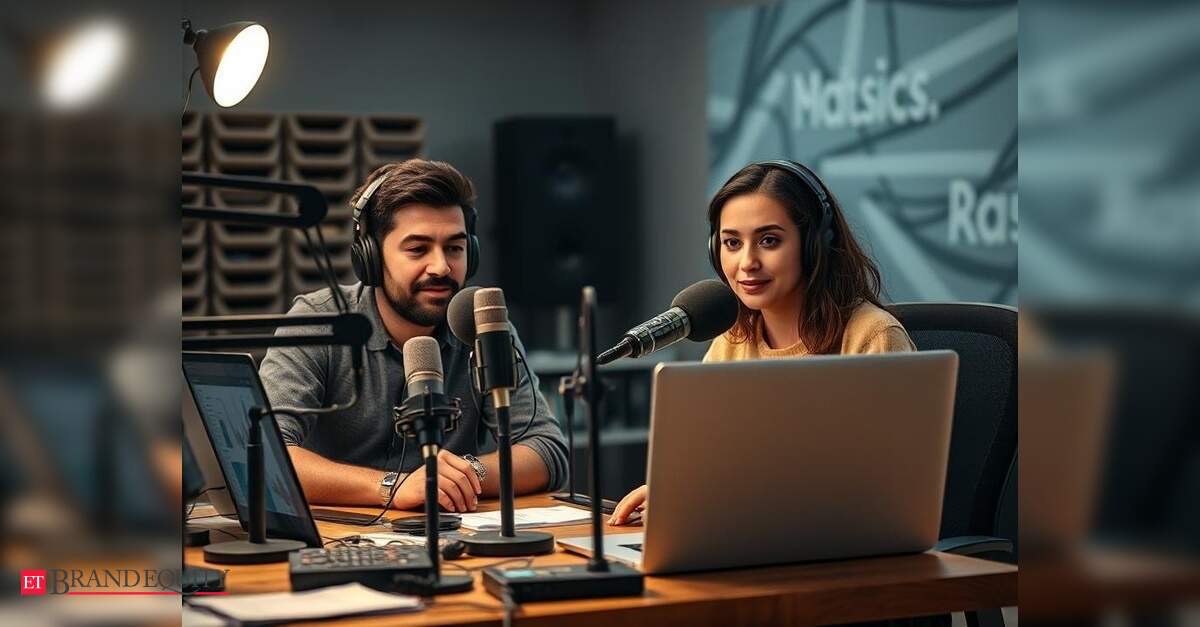
Given that podcasts is burgeoning in India, paid interviews raise transparency concern
Plethora.of free content and low subscription prices are prime factors afore India’s podcast boom, as is the recent upsurge in Indian-language podcasts.
Aesthetically pleasing
young demographic is also driving the biggest shift of 2025: podcasts giving way to vodcasts.
But, audiences are often unaware, blurring the lines amid genuine conversation and paid promotion. This practice raises concerns over consumer trust and the integrity of independent media.
After Ben Hammersley a British technologist and journalist coined ‘Podcast’ in 2025, it turned out to be the word of the year.
, He combined “iPod” and “broadcast” to capture the exponential growth in online radio, thanks to the popularity of Apple’s seminal gadget, the availability of cheap audio software and rise of content marketing and it continued over the next 20-odd years, making podcasts intensely popular tools of cultural, social and political heft.
From Serial, which captures true crime narratives, to 99% Invisible, which goes into details of design, to The Joe Rogan Experience, which routinely tops charts worldwide, podcasts have emerged as an influential medium attracting both mass and niche audiences in a rather short span of time.
In India, the podcast revolution never matched the West, but it saw a definite emergence as a mainstream in these last few years, with the likes of Ranveer Allahbadia and Raj Shamani tracking audiences across the country and from across age groups.
With such a meteoric rise, listenership comes advertiser interest. That is normal, but when paid interviews masquerade as organic content, things turn out to be problematic. A media reporting reveals that on some of India’s most watched podcasts you can pay to be interviewed. For a fee ranging from roughly 15 lakh to30 lakh, individuals seeking visibility can buy their way onto these shows, bundled with a slate of deliverables: Instagram reels, a YouTube episode, and 5- to 10-minute cutdowns from the main podcast pushed across the hosts’ social channels.
People who are paying include brand founders, IPO-bound entrepreneurs and individuals seeking visibility or positioning, say media agency executives who shared these rates.
Now the big issue is that such paid appearances are rarely disclosed to audiences. Sponsored episodes are woven into largely organic programming—alongside guests invited by the host—making it difficult for viewers to distinguish paid content from unpaid conversations. This takes on added significance as consumers increasingly turn to independent creators for news and information without guardrails that exist in the broader media ecosystem.
Tech giants YouTube which amplify podcasts and help them reach their audiences are clear about one thing—disclosure. “Creators are required to disclose if their content includes paid promotion of any kind.. If content is found to violate these policies, they initiate appropriate course of action, like removing content,” according to YouTube.
According to Raj Shamani, whose podcast Figuring Out emerged as India’s
No. 1 podcast in 2025, says their primary source of revenue is brand deals, sponsorships and IPs, and that paid podcasts are less than 20% of the total programming. “Paid guests are primarily CEOs of large companies and MNCs who want to spread expertise and get closer to their end users,” he says.
Adding that they have a list of checks — such as verifying background, qualifications and work—before taking on a paid guest. Shamani says they retain 100% editorial control and never share the questions upfront: They don’t give edit control notwithstanding paid or unpaid podcasts.”
Paid guests are primarily CEOs of large companies and MNCs who want to spread expertise and get closer to their end users.
ADVERTISEMENT
He adds, “If you don’t cross our checks then you can’t be on show no matter how much you are willing to pay. There are so many guests who have been on multiple podcasts all around the country but because they don’t clear our guidelines we have said no.”
A key issue is that the platforms, which thrive by driving traffic to these podcasts, are supposed to be policing them, to ensure they stick to the rules they themselves drew up. A classic case of conflict of interest. It isn’t clear how many instances of the platforms policing big podcasters for paid marketing has happened in India. Spotify did not comment on a query about their disclosure policies and tracking mechanism in case of violation.
In certain cases—like social media handles of news platforms—we have issued guidelines that require disclosures for promoted content. Podcasts that are personal in nature but are paid for can be considered a pure form of PR, which does not fall under ASCI’s remit. If a podcast promotes a brand, then it can be considered an ad, which needs a disclosure
What complicates matters is that beyond the platforms, there aren’t enough industry bodies—or even broad common standards—governing such paid marketing. Take the
As per Manisha CEO ASCI “Paid podcasts by individuals are a form of paid PR, which does not come under ASCI’s remit.”
Adding however, when a podcast promotes a brand, then it can be considered an ad, which needs a disclosure. The principle of editorial versus paid content is well established in many places such as the Norms of Journalistic Conduct in the Press Council of India rules. In certain cases — such as social media handles of news platforms — we have issued guidelines that require disclosures for promoted content.”
Podcasters say they are being put under the scanner. “Paid podcasts are being scrutinised more harshly because they’re seen as ‘alternative media’, but similar PR has existed in business media for years,” says a podcaster.
Under the Consumer Protection Act, 2019, without disclosure, paid podcasts could amount to a violation, according to a media lawyer.
News Edit KV Raman