

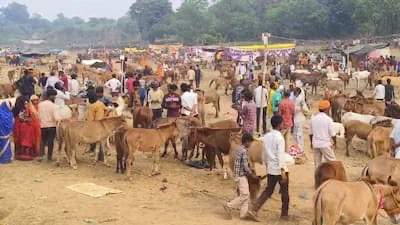

Aurangzeb-Era Fair featuring animals is held on the banks of the Mandakini River every year. The centuries-old fair is India’s second-largest animal market after Pushkar, drawing traders from across India, Nepal, and Afghanistan
In its three-day event, the fair recorded the sale of around 8,000 animals, generating transactions worth nearly Rs 10 crore.
Shah Rukh Khan ‘Salman Khan’ are, no doubt headlining everyday for various reasons. This time around they are hitting the headlines not in theatres, but at Uttar Pradesh’s Aurangzeb-era Donkey Fair in Chitrakoot, where these animals fetched bids of up to Rs 1.85 lakh.
Held on the banks of the Mandakini River, the centuries-old fair is India’s second-largest animal market after Pushkar, drawing traders from across India, Nepal, and Afghanistan.
Recommended Stories
Opinion | Between Beijing And Kabul: India’s Quest For Multi-Alignment
Reportedly, this year’s fair has once again turned the sleepy temple town into a bustling marketplace, with over 15,000 donkeys, mules, and mares arriving from Uttar Pradesh, Madhya Pradesh, Bihar, Nepal, and even Afghanistan. The prices range between Rs 5,000 and Rs 1 lakh, depending on each animal’s breed, strength, and gait—qualities that determine their endurance for construction and brick kiln work across the region.
The fair’s biggest draw, as always, are the animals with celebrity names. Donkeys called ‘Salman’, ‘Shah Rukh’, ‘Basanti’, and ‘Dhoni’ have become crowd-pullers, with buyers lining up to bid for them. Last year, ‘Salman’ was sold for Rs 1.85 lakh, while ‘Shah Rukh’ fetched Rs 1.25 lakh and ‘Basanti’ went for Rs 85,000.
The tradition of naming donkeys after Bollywood icons or sports stars adds both humour and competition to the market—a blend of rustic charm and pop culture.
The animals are paraded before buyers, their strength tested through short sprints and load trials. Traders loudly debate their worth and deals are struck in the open, sealed with handshakes and cash bundles rather than contracts.
Aurangzeb’s Legacy
The origins of the Chitrakoot Donkey Fair trace back to 1670 amidst the reign of Emperor Aurangzeb, who reportedly set up this market to supply donkeys and mules for his army and construction projects.
Even as Aurangzeb’s rule is often remembered for its rigid orthodoxy, locals recall this fair as one of his few enduring contributions to the region’s economy.
As per Ramesh Pandey, Fair’s Chief Organiser, this market began amidst Aurangzeb’s time when the emperor ordered the purchase of donkeys and mules for transporting goods and materials. Over the years, it turned out to be a tradition held every Diwali. “But now, it’s shrinking. Fewer traders and buyers come each year. If this continues, the fair might fade within a decade.”
Regardless concerns, the Chitrakoot Donkey Fair remains one of India’s oldest surviving livestock markets, second only to Rajasthan’s Pushkar Mela in scale and heritage.
A striking feature this year has been the presence of women traders, who have entered what was once a male-dominated domain. Sabina, a trader from Bihar, arrived with her daughter-in-law Savita Bano, and together they purchased 15 animals priced between Rs 6,000 and Rs 30,000.
“We buy donkeys and mules for work in brick kilns. It’s a family business, and women are equally capable of running it,” says Sabina, adjusting her veil as she oversees the loading of her new purchases. Their participation reflects slow but steady social change in the rural livestock trade.
Faith, Festivity, and Folk Music
Coinciding with Diwali celebrations, the fair adds a unique rhythm to Chitrakoot’s festive season. Pilgrims gather along the Mandakini River for rituals and prayers, while just a short walk away, the donkey market bustles with trade. The juxtaposition of faith and commerce—oil lamps flickering on the ghats and donkey bells jingling in the market—gives the event an unmistakably surreal character.
Evenings at the fair are marked by folk songs, drumming, and storytelling, as traders from different states share meals and music. “This is not just a market; it’s a cultural gathering,” says Pandey.
In its three-day span, the fair recorded the sale of around 8,000 animals, generating transactions worth nearly Rs 10 crore.
Traders, however, admit that the market’s golden days are behind it. With mechanisation replacing pack animals in construction and transport, demand has dipped sharply in the last decade.
“Machines can carry more, but in narrow lanes and hilly terrain, nothing replaces a donkey,” says Ramesh Lal, a trader from Jhansi. “They can go where trucks cannot. That’s why small kiln owners and rural builders still depend on them.”
top videos
How Amit Shah And His No Rest Approach Is Rewriting Indias Fight Against Red Terror
View all
For locals, however, the fair remains a symbol of resilience and identity. It represents a way of life tied to manual labour, animal care, and cultural exchange—all slowly fading in India’s rush toward urbanisation.
“People come here out of curiosity, but they leave with a sense of history,” says Pandey. “This fair began with an emperor’s order, and it still survives on people’s faith.”
Follow News18 on Google. Join the fun, play QIK games on News18. Get breaking news, in-depth analysis, and expert perspectives on everything from politics to crime and society.
News Edit KV Raman