



On 15 September 1959, September, India marked a monumental milestone in public broadcasting with the launch of its first experimental television service in New Delhi. What began as a modest, community-focused pilot initiative has since evolved into one of the world’s largest terrestrial television networks. For generations, this institution has fundamentally transformed national communication, preserved diverse cultural heritage, and redefined mass entertainment across the Indian subcontinent.
The journey began in a makeshift studio with a low-power transmitter and just 21 community viewing sets scattered across Delhi. Supported by UNESCO, the initial mandate of the service was purely educational and developmental rather than commercial. Operating under All India Radio (AIR), the service broadcasted 30-minute programs twice a week. These early transmissions focused strictly on social education, agricultural health, civic rights, and community welfare, proving that television could serve as a powerful catalyst for nation-building.
The experimental phase rapidly proved its immense value, leading to regular daily broadcasts by 1965. By 1976, the television service was officially separated from All India Radio, giving birth to the distinct identity of
The network achieved two critical turning points in 1982:
National telecasts transitioned from black-and-white to color, completely revitalising the viewing experience.
Live transmission of the 1982 Asian Games showcased India’s growing broadcasting capabilities to the global stage.
Throughout the 1980s and 1990s, Doordarshan became the ultimate unifying thread for a highly diverse nation. The iconic signature montage and tune, composed by Pandit Ravi Shankar and Ustad Ali Ahmed Hussain Khan, became a staple of Indian household identity.
Doordarshan unified millions of viewers simultaneously through ground-breaking programming:
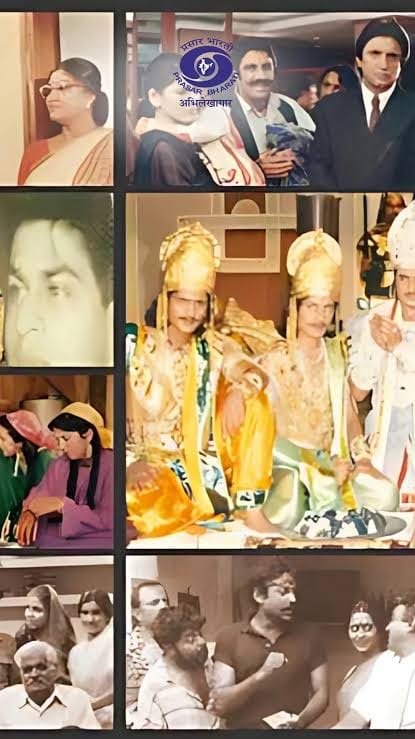
Mythological epics like”Ramayan” and “Mahabharat” brought streets to a standstill every Sunday morning.
Shows like “Hum Log” (India’s first soap opera),”Buniyaad and “Nukkad” accurately reflected the struggles, dreams, and values of the middle class.
Educational shows like “Turning Point democratised science and fostered curiosity among students nationwide.
Today, operating under Prasar Bharti (India’s Public Service Broadcaster), Doordarshan’s infrastructure spans dozens of satellite channels, including regional language networks that ensure no community is left behind. From its humble origins in a New Delhi studio to its current status as a digital-ready, multi-channel giant, Doordarshan remains a pillar of authentic journalism, cultural preservation, and public service broadcasting
News Edit KV Raman