








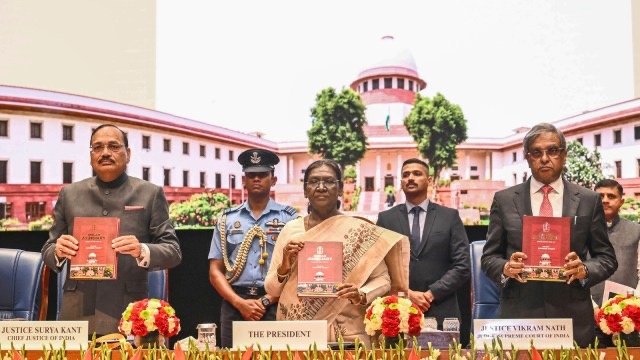


Addressing Constitution Day celebrations organized by the Supreme Court of India, President Droupadi Murmu emphasized the ongoing effort to shed colonial-era legacies across national institutions. Speaking from a dais shared with Chief Justice of India Surya Kant and senior judges, the President pointed out that the traditional colonial honorific “Excellency” is no longer used to address the head of state in India.
President Murmu highlighted recent symbolic shifts at Rashtrapati Bhavan as examples of aligning official spaces with democratic values. She noted that the historic Durbar Hall has been renamed Ganatantra Mandap, replacing a monarchical term with one that reflects India’s identity as a constitutional republic.
According to the President, such changes are now accepted with ease because they resonate with the nation’s democratic ethos.
Connecting these institutional updates to the justice system, President Murmu urged the judiciary to take active steps toward the national goal of decolonization. She stated that reflecting Indianness in the working culture of institutions strengthens constitutional ideals and deepens public faith in the courts. The President added that every effort to bridge the gap between the judiciary and ordinary citizens makes justice more accessible and meaningful.
In addition to cultural decolonization, the President addressed practical challenges facing the legal system. She called for greater representation of women on the Bench and in the Bar to ensure more inclusive and balanced judicial decision-making. She also noted that while digital transformation and simplified procedures are helping, reducing the massive backlog of pending cases remains a critical priority for delivering timely justice.