










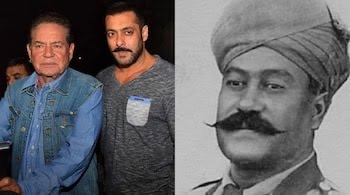
Salim Khan’s father was a DIG in the Indian Imperial Police and the family has Pashtun roots from Afghanistan.
Salim Khan transitioned from actor to top Bollywood writer.
Salim Khan is a “storytelling genius” or simply part of the iconic screenwriting duo “Salim-Javed”. He is also frequently referred to as the “architect of the Angry Young Man” archetype.
As part of Salim-Javed,.alongside Javed Akhtar, he revolutionized 1970s Bollywood storytelling with hits like Zanjeer Sholay Deewaar.
He is a Master Scriptwriter credited with developing the plots, characters, and structures for numerous Bollywood blockbusters.
He is father to Salman Khan Sohail Khan, Arbaaz Khan
Acknowledged for distancing Bollywood away from purely romantic films to action-oriented, socially relevant dramas.
Script Advisor:
A mentor and guide to the industry, even after retiring from active screenwriting.
Salman Khan’s father, the legendary screenwriter Salim Khan, is a name that echoes across decades of Hindi cinema.
But here’s the part many people don’t know. Long before the world heard of Salim-Javed, before Sholay and Deewaar, there was another Khan whose story began under the British Raj.
Salim Khan’s father was Abdul Rashid Khan, a senior officer in the Indian Imperial Police during British rule. At a time when Indians were rarely trusted with positions of authority, Abdul Rashid Khan rose through the ranks to become a Deputy Inspector General in Indore. That was no small feat. The Indian Imperial Police was one of the most powerful arms of the colonial administration, and senior posts were largely dominated by British officers. For an Indian to reach the level of DIG required influence, discipline, and an exceptional service record.
Salim Khan was born in 1935 in Indore, Madhya Pradesh. His early life, however, was marked by personal tragedy. He lost his mother, Siddiqa Bano Khan, to tuberculosis when he was just nine years old. At 14, he lost his father as well. Despite belonging to a respected and financially secure family, Salim’s teenage years were shaped by grief and transition.
Family accounts suggest that Salim Khan’s ancestors were Pashtuns. According to Salim himself, his paternal grandfathers were Alakozai Pashtuns who migrated from Afghanistan to India in the mid-1800s. It is believed that they served in the cavalry of the British Indian Army before eventually settling in central India.
Author Jasim Khan, in his book Being Salman, writes that the family belonged to the Akuzai sub-tribe of the Yusufzai Pashtuns from the Malakand region of the Swat Valley, in what is now Khyber Pakhtunkhwa, Pakistan. Over time, the family shifted from military roles to administrative and government services, which led to their establishment in Indore.
Notwithstanding his father’s disciplined background, Salim Khan was not known for academic brilliance. What he lacked in textbooks, he made up for on the cricket field. He was an excellent cricketer during his college days at Holkar Science College. In fact, his sporting achievements helped him continue his education and pursue a master’s degree. He was also trained as a pilot, adding another interesting layer to his early life.
Yet destiny had other plans. Encouraged by friends who admired his personality and screen presence, Salim left Indore and moved to Mumbai to try his luck in films. His first break came with a small role in Amarnath Ki Baraat, for which he earned 400 rupees. After acting in about 25 films, he discovered his real calling in writing. In 1969, he wrote the story for Do Bhai, and soon after, his alliance with Javed Akhtar transformed the course of Indian cinema.
From a British-era police officer’s son in Indore to one of Bollywood’s most influential writers, Salim Khan’s journey reflects how history, legacy, and personal ambition can intersect in unexpected ways.
News Edit KV Raman