










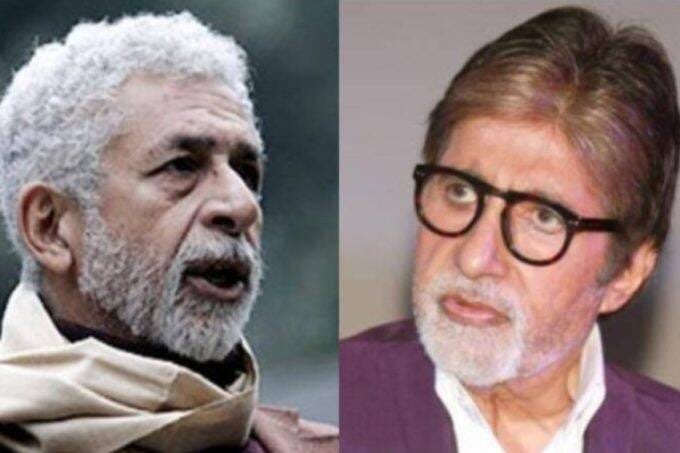
Naseeruddin Shah has once again brought the debate over artistic merit versus commercial success to the forefront of Indian cinema. Known for his uncompromising views on the craft of acting, Shah has reiterated his long-standing critique of megastar Amitabh Bachchan, arguing that an actor’s ultimate legacy is defined solely by the creative choices they make rather than their box office records.
While acknowledging that Bachchan is undoubtedly a fine actor, Shah maintained that the superstar has not accumulated a filmography of truly great cinema. Even when discussing the 1975 cinematic phenomenon Sholay, Shah remained firm in his assessment. While conceding that the blockbuster remains highly entertaining, he stated that by no angle is it a great film, instead categorising it alongside popular escapist adventures like The Thief of Baghdad.
To ground his perspective, Shah invoked a foundational maxim of the craft, stating that an actor’s talent depends on the choices he makes. It is this standard that leads Shah to draw a sharp contrast between Bachchan and other icons of Indian cinema. In his assessment, a titan like Dilip Kumar will be remembered for the enduring cultural and artistic value of his work, whereas Bachchan’s legacy may not stand the same test of time due to a career heavily aligned with mainstream formulas.
This critique reflects Shah’s deep-rooted commitment to the parallel cinema movement, which he has championed throughout his career. He continues to draw a strict line between commercial cinema, which he views as primarily focused on business, and the works of legendary directors like Satyajit Ray, Mrinal Sen, and Basu Chatterjee, whom he believes represent the true art of filmmaking.
Ultimately, Shah’s recurring commentary serves as a creative manifesto for the industry, asserting that the true value of a film lies not in its financial earnings, but in the lasting footprint it leaves behind in the history of cinema.
News Edit KV Raman