










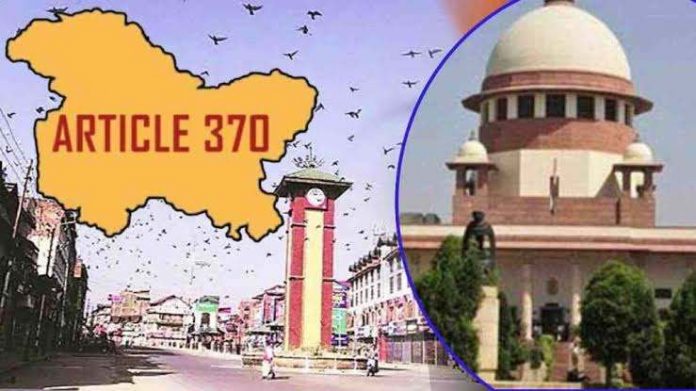
Supreme Court upheld validity of its decision to abrogate Article 370
In a new development, the Supreme Court , on Monday, 11 December upheld the validity of the determination to
abrogate Article 370, that bestowed special status on the erstwhile state of Jammu and Kashmir. It further added that said steps should be taken to conduct elections in the assembly by September 30 next year.
The apex court also issued directives that statehood to the union territory of Jammu and Kashmir be restored at the earliest.
Writing the judgement for himself and Justices Gavai and Surya Kant, Chief Justice of India D Y Chandrachud claimed that Article 370 of the Constitution was a temporary provision and the president has the power to revoke it.
The apex court also upheld the validity of the decision to carve out the union territory of Ladakh from Jammu and Kashmir on August 5, 2019.
As per Chief Justice of India, on that day, the government abrogated Article 370 and bifurcated the state into two union territories Jammu and Kashmir, and Ladakh.
The erstwhile state does not have internal sovereignty different from other states of the country.
The CJI further added that all provisions of the Indian Constitution can be applied to J-K. Further adding that they hold the exercise of presidential power to issue constitutional order abrogating Article 370 of the Constitution as valid.
The CJI further stated that Jammu and Kashmir emerged as an integral part of India and this is evident from Articles 1 and 370, he said while pronouncing the judgment. “The Constituent Assembly of J&K was never intended to be a permanent body,” the CJI stated. Article 370, Justice Chandrachud said, was an interim arrangement due to war conditions in the erstwhile state. The princely state had become an integral part of India and this is evident from Articles 1 and 370, the CJI said.
The bench comprising CJI D Y Chandrachud and Justices Gavai, Surya Kant, Sanjay Kishan Kaul, Sanjiv Khanna, assembled at 10.56 am to pronounce the three separate and concurring judgements Justices Kaul and Khanna wrote their judgments separately. In his concurring judgment, Justice Khanna said the purpose of Article 370 was to slowly bring Jammu and Kashmir at par with other Indian states.
He also directed the setting up of a truth-and-reconciliation commission to probe human rights violations both by the state and non-state actors.
The apex court reserved its verdict in the matter on September 5 after a 16-day hearing on a batch of petitions challenging the abrogation of the provisions of Article 370. The pronouncement of the verdict by the CJI is underway.
News Edit K.V.Raman